
Quick Summary
Instantly’s plans start low, yes. But the contact caps, paid add-ons, and sending limitations can rack up the monthly bill fast. In this review, we’ll break down how exactly those tradeoffs work in practice, and where RB2B becomes a more effective and efficient growth investment.
What Does Instantly Offer and Is It Right for You?
Instantly’s pricing looks refreshingly simple at first glance. Low monthly fees, "Unlimited" email accounts, with warm-up included. An easy yes for outbound teams.
But once you run real campaigns, the focus on pricing shifts from the headline plan to its limit: the number of contacts you’re allowed to upload, how many emails you can send, and what you pay to expand those ceilings. Add-on lead generation and AI functionality, and “cheap” gets expensive real quick.
This review breaks down what you really pay, where costs creep in, and where RB2B becomes the smarter spend.
Why Listen to Us?
At RB2B, we focus on pricing through the lens of pipeline efficiency. This review closely examines Instantly’s plan limits, add-ons, and usage rules, then uses RB2B as a reference point for alternative pricing models to give teams a better understanding of where real costs emerge as usage grows.
Instantly’s Pricing Plans Compared at a Glance
Breakdown of Instantly Outreach’s Pricing Tiers
Besides Superseach, and their CRM, Instantly’s core product is its Outreach offering, which governs contact uploads and monthly email volume. Pricing below reflects annual billing equivalents based on publicly available information and user reports.
Outreach
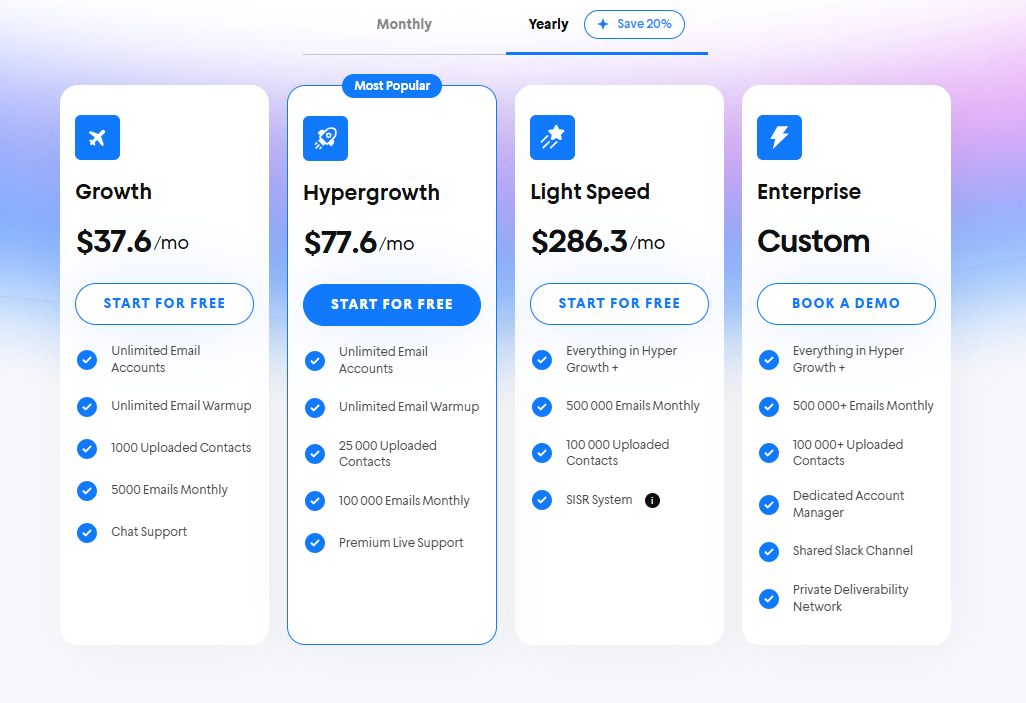
Instantly’s outreach plan is structured around contact limits and monthly email volume. It is divided into four sections, namely:
1. Growth Plan
The Growth plan is Instantly’s entry-level Outreach tier, at $37.6/month (billed annually), consisting of a limited number of uploaded contacts and a capped monthly sending volume, alongside unlimited email accounts and warmup, making it fantastic for solo founders and small teams.
In practice, this tier works when campaigns are small, lists are tightly managed, and outreach volume stays predictable. Once teams begin testing multiple segments or running concurrent campaigns, contact limits tend to be the first constraint.
2. Hypergrowth Plan
Pricing for the Hypergrowth Plan is set at a $77.6/month (billed annually) with an option to start for free. It features a significantly increased uploaded contact limit and monthly sending capacity. Instantly positions this tier for teams running outbound at scale, including agencies and dedicated SDR teams.
However, Hypergrowth is also where pricing becomes more layered. Teams that exceed contact caps or sending limits often rely on paid add-ons, and teams using lead sourcing, enrichment, or AI features usually add a separate credits plan.
3. Lightspeed Plan
At $286.3/month (billed annually), the Light Speed plan sits above standard self-serve pricing and is positioned for high-volume outbound operations. Limits, infrastructure, and support are more flexible at this tier, with pricing determined based on usage and requirements.
This tier is best understood as a custom outbound solution rather than a fixed monthly plan, designed for teams that already know their scale and volume needs.
4. Enterprise Plan
Credits are required for features outside basic sending, including lead generation through SuperSearch, enrichment and verification workflows, and AI-powered tools.
Credits are purchased separately from Outreach plans, meaning many teams effectively operate with two subscriptions: one for sending capacity and the other for data and automation. This separation is central to how Instantly’s real monthly cost is determined.
Supersearch
Instantly’s SuperSearch pricing has four tiers focused on lead generation features. Growth ($42.3/month) includes access to a 450M+ B2B lead database, the web researcher agent, the email writer agent, and AI usage. Supersonic ($87.3/month) adds higher monthly credit limits, while Hypercredits ($177.3/month) significantly increases available credits for large-scale lead sourcing. The Enterprise plan has custom pricing for large teams needing 200,000+ credits.
CRM
Instantly’s CRM has two tiers with features designed to maximize customer engagement. Growth ($37.9/month) includes unlimited seats, a master inbox, detailed lead views, campaigns, reporting, and integrations. Hyper CRM ($77.6/month) adds more AI, calling and SMS, salesflows, website visitors in CRM, advanced team reporting, plus priority AI, follow-up AI, and Stripe integration, marked as coming soon.
Features of Instantly
Here are a few reasons why some teams choose Instantly:
1. Cold-Email Campaign Management
Instantly gives teams the opportunity to create and run multi-step cold email sequences across many inboxes from one place. Campaign controls are built for volume and testing, with basic levels of personalization, scheduling, and reply handling included.
2. Unlimited Email Accounts and Warmup
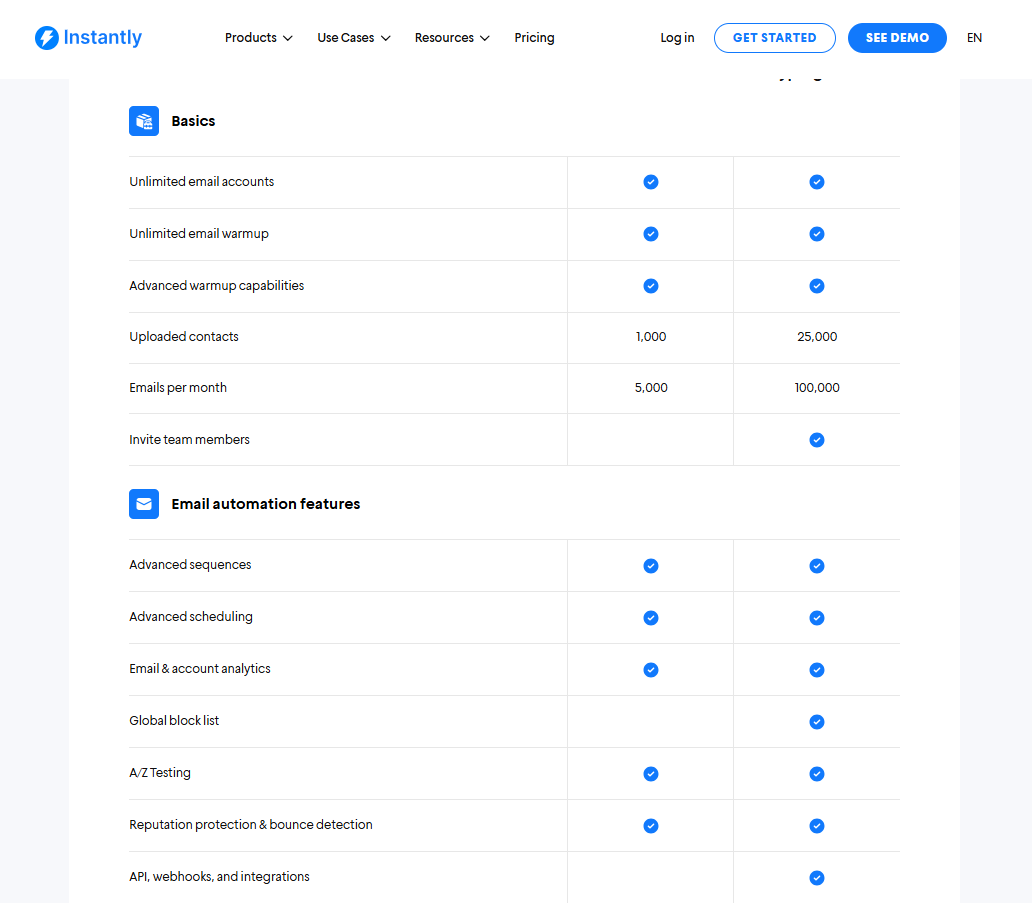
All plans include unlimited email accounts with automated warmup. This aids in maintaining deliverability as volume increases, although real-world sending capacity is still run by plan-level limits and account reputation.
3. Lead Sourcing and Data Workflows
Instantly offers built-in lead sourcing alongside enrichment and verification tools. These features operate on a credit system, meaning data workflows introduce an additional usage-based cost beyond the core plan.
4. AI-Assisted Outreach and Replies
AI tools support message drafting, reply handling, and follow-ups to reduce manual work. Usage solely depends on available credits, so teams choosing to rely heavily on AI should factor this into ongoing cost and planning.
Costs and Pricing Limitations of Instantly
Instantly is definitely a high-end CRM and lead generation tool, but there are several cost-related drawbacks that have been identified by users. These include:
1. Uploaded Contact Limits Apply Across Campaigns
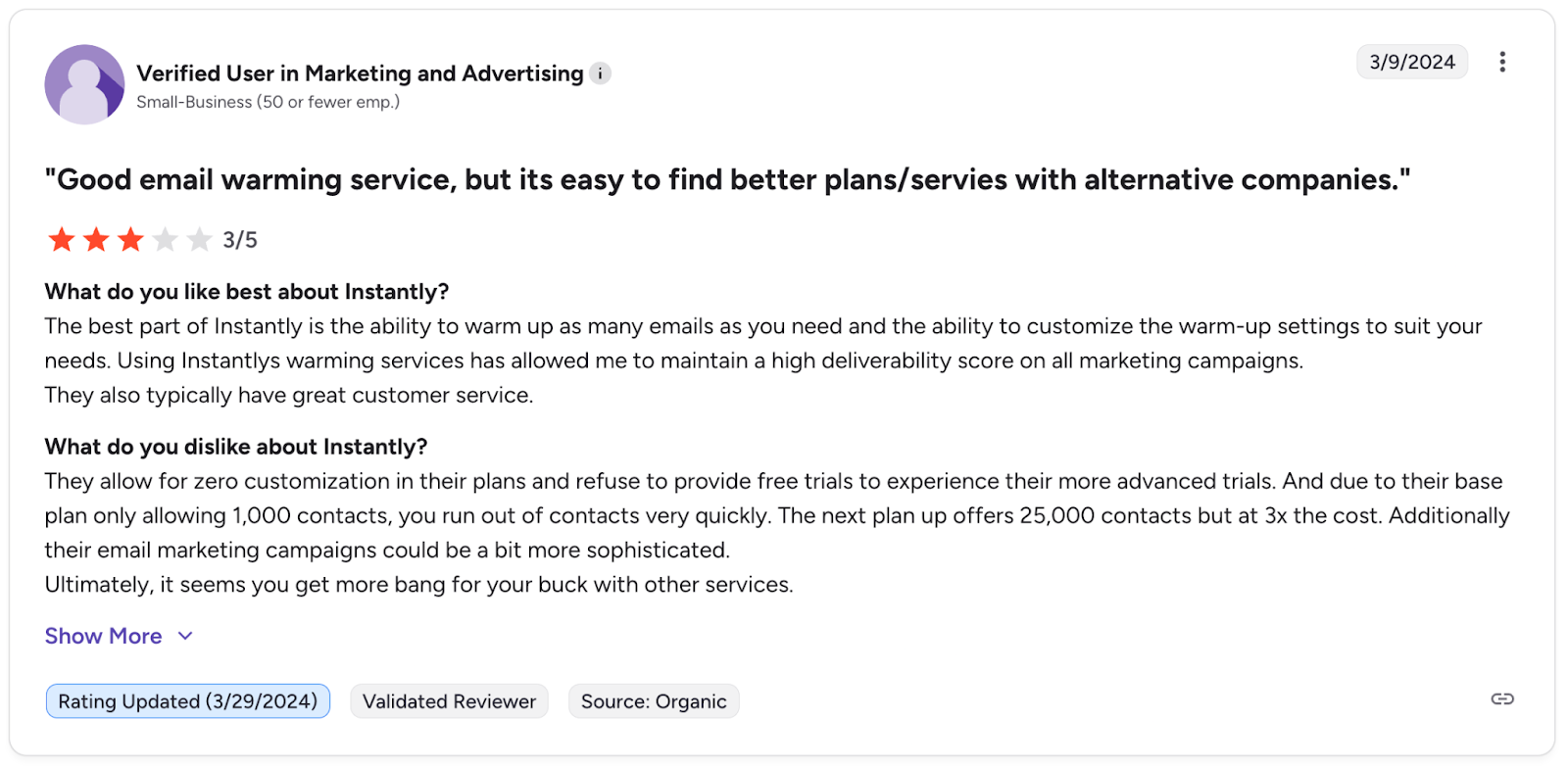
Instantly puts a cap on how many contacts you can upload per plan, with the count including active, paused, and draft leads. This means normal campaign hygiene, like testing segments or pausing outreach, still consumes massive capacity and can push teams toward higher tiers or paid expansions sooner than expected.
2. Credits Introduce a Second Pricing Layer
Many of Instantly’s advanced workflows, including lead sourcing, enrichment, verification, and AI features, rely on a separate credit system. Teams using these features regularly may end up managing two parallel subscriptions, further complicating budgeting and making true monthly costs harder to forecast.
3. Sending Volume Is Still Plan-Bound
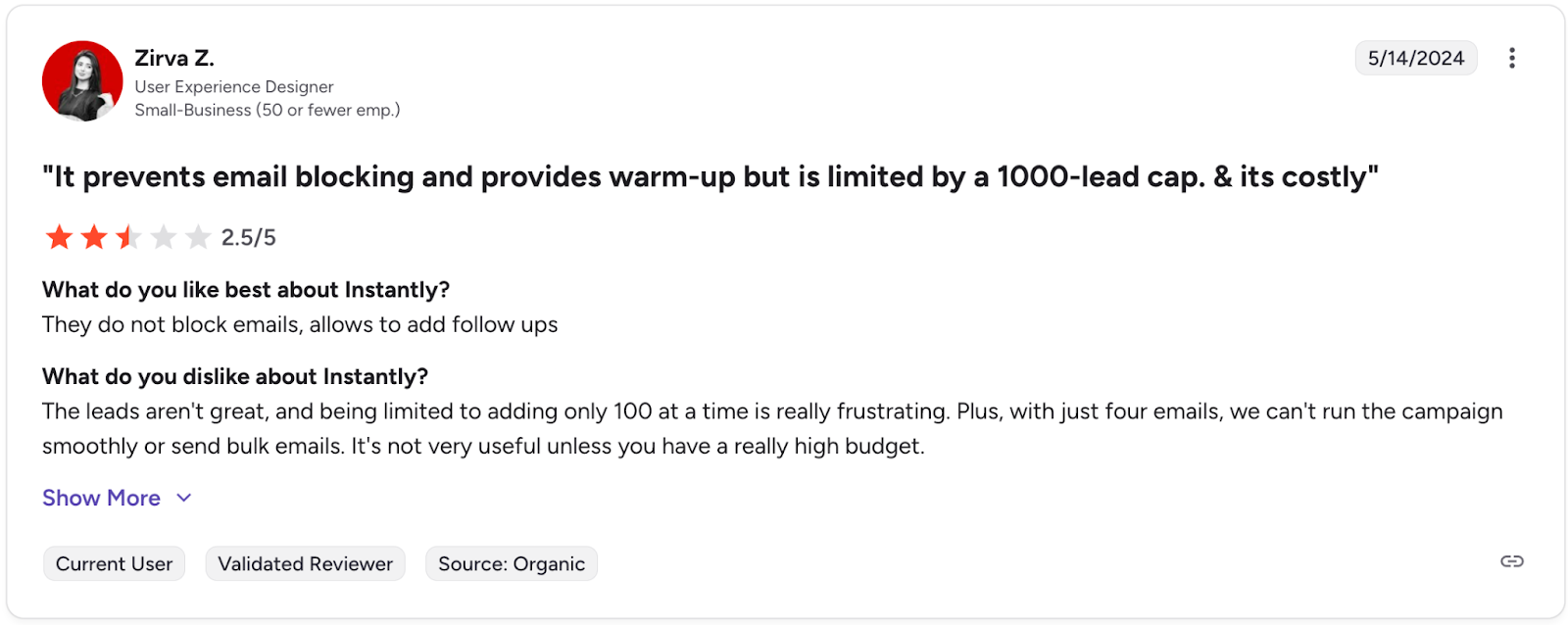
Although Instantly promotes unlimited email accounts, actual sending capacity is governed by plan-level limits. This distinction matters for teams scaling outreach, as adding inboxes alone does not increase volume. Higher sending needs typically require plan upgrades or add-ons, not just more accounts.
5. Trials Don’t Reflect Real Usage Patterns
Instantly’s free trial comes with restrictions that limit how accurately teams can test real-world workflows. Since key constraints around contacts, sending, and credits may not appear during a trial, teams can underestimate future costs when transitioning to full-scale usage.
Why RB2B Is a Better Alternative to Instantly
Instantly is built to create demand through outbound. RB2B, on the other hand, is built to capture demand that already exists. For teams focused on pipeline efficiency rather than outreach volume, RB2B offers a clear-cut model and stronger alignment with how B2B buyers actually convert.
Four reasons why RB2B beats Instantly include:
1. Pricing Aligns Directly with Pipeline Outcomes
RB2B pricing is tied to resolutions, a concrete unit connected to leads and opportunities. There are no contact upload caps, sending limits, or stacked add-ons to manage. This makes it much easier to understand how to spend maps on results, especially for teams tracking cost per opportunity.
2. No Artificial Limits on Normal Workflows
Instantly’s pricing constraints are triggered by common outbound behaviors, like testing segments or pausing campaigns. RB2B does not penalize teams for normal usage patterns. As traffic grows, pricing scales predictably without forcing structural changes to how teams operate or experiment.
3. Capturing Existing Demand Instead of Manufacturing It
Outbound tools like Instantly require ongoing spend to generate attention. RB2B converts anonymous website visitors who already show intent. This shifts spend from demand creation to demand capture, which often produces higher conversion rates and a faster time to pipeline.
4. Simple Cost Forecasting as Teams Scale
Whilst using Instantly, scaling often introduces new variables: add-ons, credits, and tier upgrades. RB2B’s model stays linear as usage grows, making budgeting and forecasting easier for RevOps and finance teams that need stable, predictable GTM costs over time.
RB2B Starter Plan vs Instantly Growth Plan
RB2B: a Clearer Path to Pipeline Efficiency
Yes, Instantly helps teams move faster on outbounding by reducing manual work across writing, replies, follow-ups, and everything in between. Ultimately, RB2B gives teams a better and more monitorable way to efficiently convert existing website traffic into a qualified pipeline. With outcome-based pricing and no artificial usage limits, it offers a more transparent alternative to outbound tools as GTM complexity grows.
Start on the growth plan, get your team on board, plug in your channels, and see just how well it handles tickets. Book a demo today and get your customer service delivery to the next level.