
Quick Summary
Leadinfo is meant to help B2B teams easily identify website engagement, but its feature gaps and workflow friction often limit how it can be used on a day-to-day basis. This review breaks down Leadinfo’s plans, real costs, and limitations, then explains how and why RB2B is the better alternative.
What Does Leadinfo Offer B2B Sales Teams?
As a B2B sales lead generation tool, Leadinfo helps teams identify which companies are visiting their website, which content they engage with, and how those visits tie back to campaigns. It brings visitor recognition, company identification, and basic follow-up tools into a single platform, making it especially popular with marketing teams.
That said, teams often run into practical limits once they try to use Leadinfo in day-to-day sales workflows.
In this article, we break down where those gaps show up, how pricing and feature restrictions affect real usage, and why many sales teams end up choosing RB2B instead.
Why Listen to Us
At RB2B, we help sales teams act on real buyer intent, not static dashboards. With our platform, sales and marketing teams can identify up to 80% of their website traffic, allowing them to easily convert high-value leads and drive revenue up.
Leadinfo Pricing Plans Compared
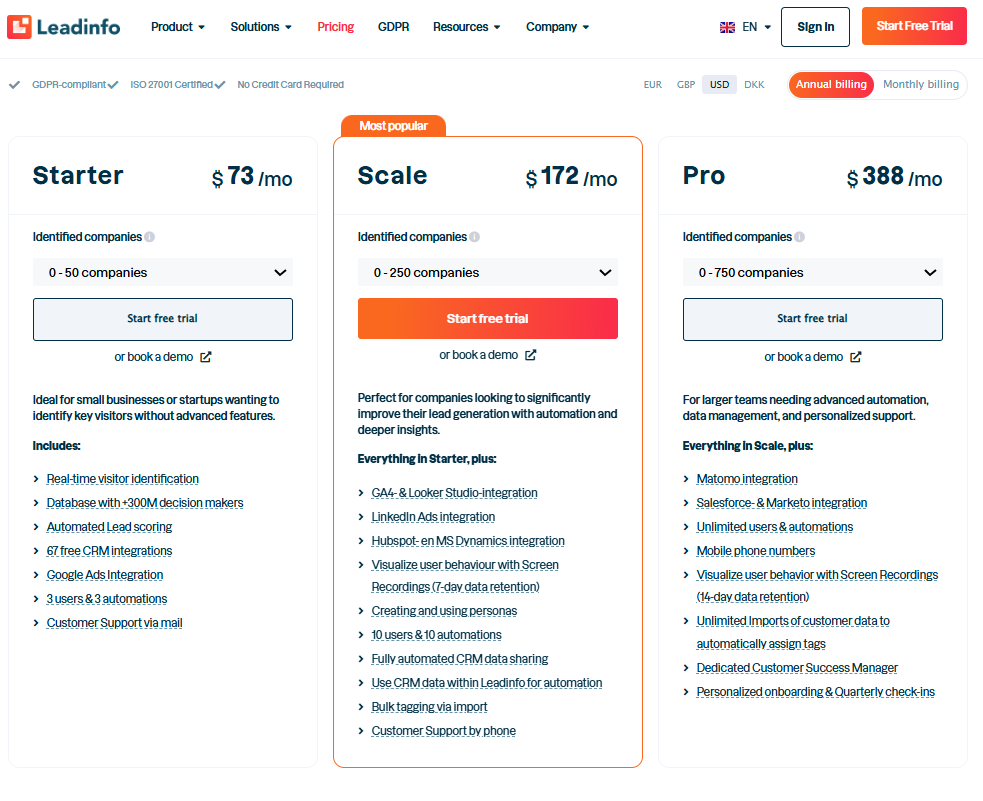
Here’s a side-by-side look at each plan, its cost, and key features to determine which one is the best fit for your needs.
Breakdown of Leadinfo Pricing Tiers
Leadinfo offers three main plans, each with its own features, limits, and ideal use cases. Here’s a comprehensive look at what’s included and what’s missing.
1. Starter Plan
Leadinfo’s most affordable plan is the Starter plan. For $73/month, teams can identify anonymous website visitors and act on them quickly. They can also access features such as real-time visitor identification, automated lead scoring, and solid integrations across multiple applications.
However, the plan is intentionally lightweight. It supports only three users and basic automations, making it best for small teams looking for visibility without complex workflows.
2. Scale Plan
The Scale Plan is where Leadinfo starts to feel operational. It increases coverage to 250 identified companies per month and removes most of the friction teams encounter on Starter as they grow.
Starting at $172/month, this tier adds automated CRM syncing, bulk data tagging, and job-based lead filtering. It’s built for more users, stronger automation, and phone support. It’s built for teams that want visitor data to directly drive the pipeline, not sit in a dashboard.
3. Pro Plan
The Pro plan is built for larger teams that want a more tailored experience that matches the platform’s most advanced capabilities. It includes personalized onboarding, unlimited users and automations, and extended user behavior recordings, giving teams deeper visibility into how prospects engage with their site.
Pricing starts at $388/month, making this plan best suited for organizations that value flexibility, customization, and hands-on support. Identification limits still apply, so teams with very high-volume needs should factor that into long-term planning.
Features of Leadinfo
Here are a few reasons why some B2B teams like to use Leadinfo:
1. Extensive Decision-Maker Database
Leadinfo gives teams access to a database of over 300 million decision-maker profiles, including LinkedIn profiles, email addresses, and phone numbers. This could reduce the time teams spend researching who to contact, although they still have to confirm buying intent.
2. IP-Based Website Visitor Identification
Leadinfo tracks IP information to immediately identify which companies are visiting your site. This turns anonymous traffic into clear company-level insights, which could help spot buying intent.
However, identification stops at the company level. It does not reveal which individual is visiting, and accuracy can vary depending on network setups, shared IPs, or remote work environments. This is where person-level tools like RB2B differ.
3. Automated Lead Follow-Up
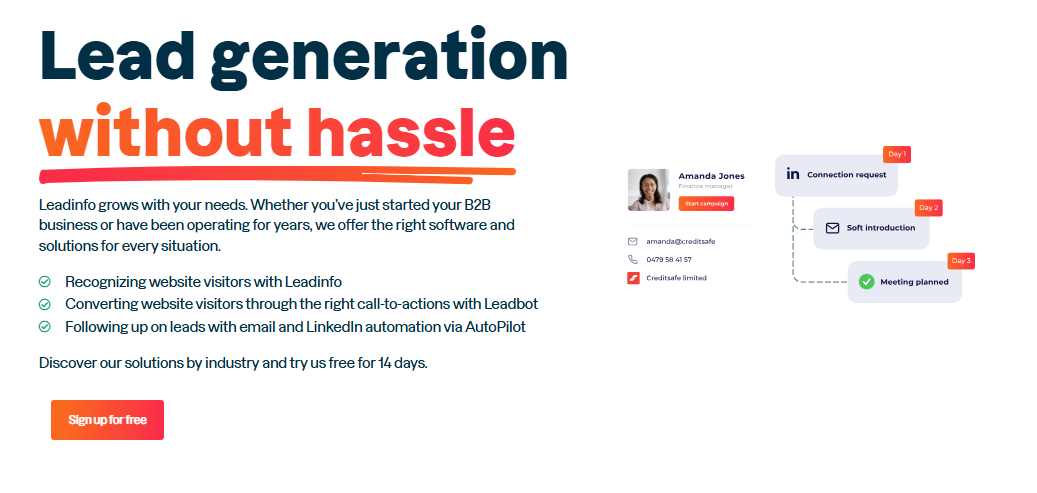
Leadinfo uses automated email and LinkedIn follow-ups to score, tag, and sync various types of leads to your CRM. These tools can help teams standardize follow-up workflows and reduce manual effort. However, teams looking for real-time activation or more advanced personalization may need additional tools or manual intervention.
4. Lead Generation Workflows
Leadinfo bridges the gap between visitor data and sales and marketing operations by passing company data into CRMs and enrichment tools. This enables teams to focus on high-intent companies, match them accurately with potential decision-makers, and convert visitors into leads.
It’s important to note that turning visitor data into immediate, actionable outreach often requires extra steps outside the platform.
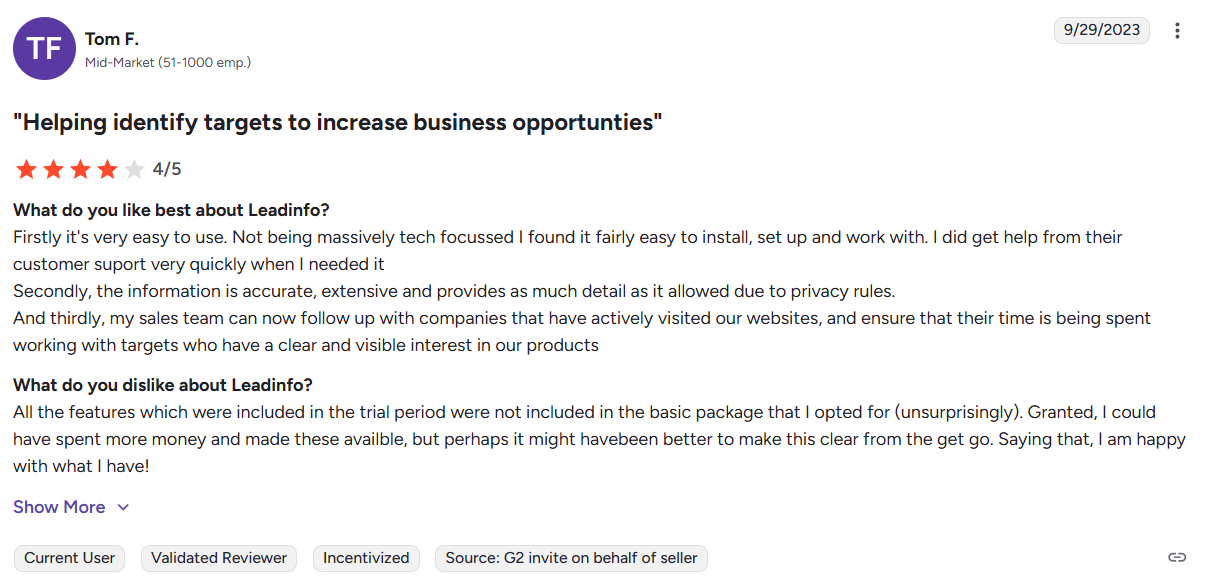
Why RB2B Is a Better Alternative to Leadinfo
For teams looking to seriously improve their lead generation with a tool that actually works, RB2B is the better alternative. It is a B2B lead generation platform that specializes in identifying individual website visitors in real time.
Whereas Leadinfo relies on traditional IP-based methods that limit its ability to identify website visitors, RB2B focuses on identifying real people and capturing intent signals, thereby improving sales outreachfor B2B teams.
Here are four reasons why RB2B beats Leadinfo:
1. Person-Level Data Identification
Leadinfo focuses on identifying corporations via IP tracing. In contrast, RB2B takes it a step further to identify individuals behind these website visits. This allows salespeople to monitor whom their website visitors are on pricing, demo, and case study pages and reach out to them when their interest level is highest.
2. High Intent Signals
The Hot Pages and Hot Leads functionality in RB2B translates website behavior to hard sales indicators. With these tools, sales and marketing teams can identify visitors accessing their content and automatically assign qualifying leads to their ICP targets. This ensures they engage only with accounts that are actively purchasing products, not merely browsing.
3. Deeper Coverage With Demandbase
RB2B combines person-level identity with Demandbase’s company-level identification, allowing teams to identify up to 70–80% of website traffic. This hybrid approach gives sales visibility into both U.S. visitors at the person level and global visitors at the company level.
4. Instant Activation
RB2B is designed to trigger action. With CRM, Slack, Clay, and outbound tool integrations, teams can route signals instantly, launch outreach, or alert reps in real time. Instead of data sitting in a dashboard, RB2B helps teams quickly turn traffic into a pipeline.
RB2B Starter Plan vs Leadinfo Starter Plan
RB2B: Lead Generation Made Easy
Leadinfo can work for teams that want company-level visibility and light follow-up. But if your goal is to turn website traffic into a real pipeline, its limits show quickly.
RB2B is built for speed, activation, and accountability. By identifying real buyers and pushing intent signals straight to sales workflows, RB2B helps teams book more meetings and move deals forward faster, without guessing who to contact today.
Start for free today, see the value, and upgrade only when you’re ready.